Discuss whether formation of new states in recent times is beneficial or not for the economy of India. (UPSC 2018)
Formation of new states in recent times has had mixed economic effects on India. It can improve governance and focus development in neglected regions, but it also creates heavy fiscal costs and resource disputes. Its overall impact depends on design, capacity and Centre-state coordination.
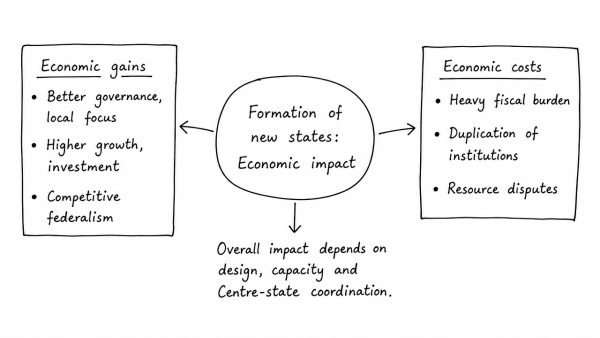
- Economic gains
- Smaller states can respond faster to local needs and use public funds more efficiently.
- New states such as Telangana and Uttarakhand have recorded strong growth, better fiscal effort and greater private investment.
- Competitive federalism has helped attract industry through simpler clearances, better infrastructure and targeted policies.
- In backward or remote regions, statehood can improve road links, irrigation, tourism and service delivery.
- Economic costs
- State formation requires new capitals, legislatures, high courts, offices and staff, which raises initial expenditure sharply.
- Division of assets, debts, water and power often leads to long legal and political disputes.
- Residuary states may lose their main growth centre, as seen in Andhra Pradesh after bifurcation.
- Growth is not always inclusive; mineral-rich states like Jharkhand still face weak human development and poverty.
- Net assessment
- New states are beneficial when created to improve administrative efficiency, correct regional imbalance and ensure strong fiscal institutions.
- They are less useful if driven by narrow identity politics without economic planning.
Thus, formation of new states is neither automatically good nor bad for the economy. It can be an engine of balanced regional growth, but only when backed by viable resources, sound finance and clear arrangements for assets, water and administration.
Originally written on
August 31, 2026
and last modified on
August 31, 2026.