Discuss the various economic and socio-cultural forces that are driving increasing feminization of agriculture in India. (UPSC 2014)
Feminisation of agriculture means the growing role of women in farm labour and farm management, largely under distress and without matching control over assets.
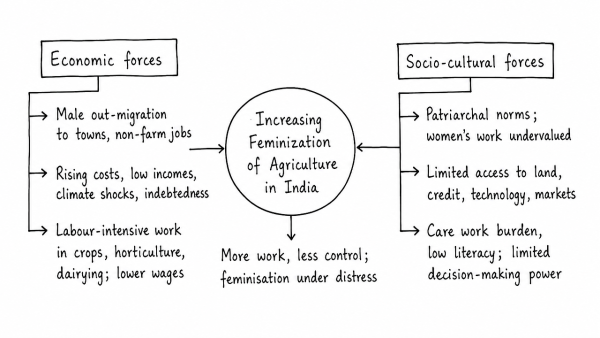
- Economic forces: Male out-migration to towns and non-farm jobs leaves women to manage farms; rising input costs, low incomes, climate shocks and indebtedness push households to depend more on women’s labour.
- Work pattern: Women are concentrated in labour-intensive operations like sowing, transplanting, weeding and harvesting, often at lower wages; expansion of horticulture, floriculture and dairying has further raised demand for their careful, repetitive work.
- Socio-cultural forces: Patriarchy restricts women’s mobility and channels them into village-based work, while norms still define many farm tasks as “women’s work”; yet they have limited access to land, credit, technology and extension.
Thus, feminisation reflects economic stress and gender inequality, calling for equal land rights, fair wages, credit, training and technology access.
Originally written on
August 29, 2026
and last modified on
September 7, 2026.