Discuss the role of the Election Commission of India in the light of the evolution of the Model Code of Conduct. (UPSC 2022)
The Model Code of Conduct (MCC) is a moral and administrative framework that seeks to ensure free, fair and peaceful elections. Its evolution shows how the Election Commission of India (ECI) has moved from persuasion to active regulation, using its constitutional authority under Article 324.
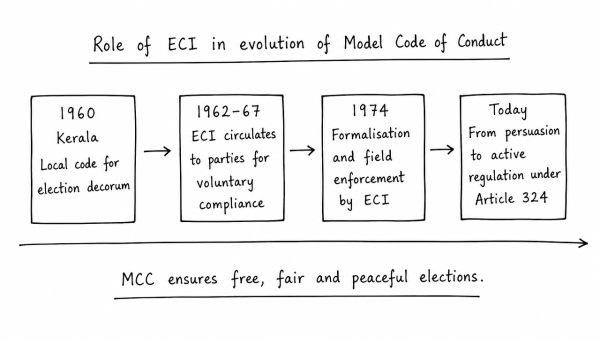
- From voluntary norms to institutional code: The MCC began in Kerala in 1960 as a local code to maintain election decorum. By the 1962 and 1967 general elections, the ECI circulated it to parties for wider voluntary compliance.
- Formalisation and field enforcement: In 1974, the ECI institutionalised the code and created district-level committees to address complaints quickly, making the MCC more operational.
- Stronger enforcement: Under T.N. Seshan in 1991, the Commission used its powers strictly, including postponement or cancellation of polls in serious cases. This gave the MCC real force and deterrence.
- Expanded scope in policy matters: After the Supreme Court’s guidance in S. Subramaniam Balaji, the MCC was strengthened with manifesto guidelines to curb irrational promises and misuse of public resources.
- Indirect legal support: Though not statutory, several provisions are backed by the Representation of the People Act, 1951 and criminal law, especially on bribery, communal appeals, intimidation and campaign silence.
- Digital adaptation: The ECI has updated the MCC for the online era through social media monitoring, platform cooperation and citizen tools such as cVIGIL for rapid complaint reporting and action.
Thus, the ECI has transformed the MCC from a consensual moral guide into an effective instrument of election management. Its role is vital in balancing persuasion with enforcement, though greater legal clarity and faster adjudication would further strengthen electoral fairness.
Originally written on
September 3, 2026
and last modified on
September 3, 2026.