Discuss the recent measures initiated in disaster management by the Government of India departing from the earlier reactive approach. (UPSC 2020)
India’s disaster management has steadily shifted from relief after calamity to risk reduction, preparedness and resilience. The change is visible in law, finance, technology and community participation, showing a more proactive and integrated approach.
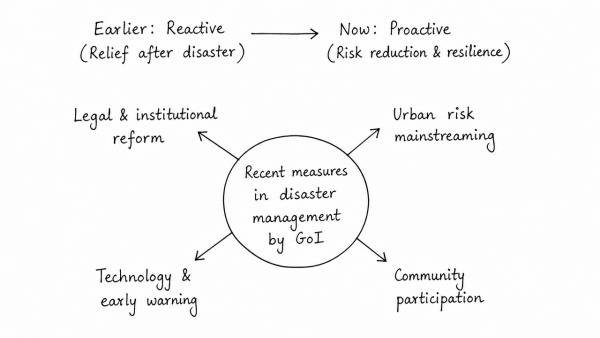
- Legal and institutional reform: The Disaster Management (Amendment) Act, 2025 gives statutory backing to stronger institutions, including Urban Disaster Management Authorities in major cities and a national disaster database. It also promotes faster local decision-making by empowering State Disaster Management Authorities during emergencies.
- Urban risk mainstreaming: Disaster mitigation is being linked with master plans and building bylaws, so urban floods, heatwaves and fire risks are addressed at the planning stage itself.
- Financial shift: Following the 15th Finance Commission, dedicated mitigation funds at the national and state levels have been created. This marks a move from spending mainly on relief to investing in prevention and structural safety.
- Early warning and technology: Mission Mausam uses better modelling and AI-assisted forecasting for cyclones, heavy rain and floods. The cell broadcast alert system through SACHET sends geo-targeted alerts directly to mobile phones in local languages.
- Hazard-specific action: India is expanding flood hazard mapping, glacial lake outburst flood mitigation and heat action plans to tackle local and climate-linked disasters in a planned manner.
- Community preparedness: Schemes like Aapda Mitra and Yuva Aapda Mitra train volunteers as first responders, helping save lives during the critical golden hour.
Overall, India is moving from a reactive relief model to a predict, prevent, prepare and respond framework. However, better implementation, local capacity and inter-agency coordination are needed to make this shift fully effective.
Originally written on
September 2, 2026
and last modified on
September 2, 2026.