Discuss the rationale for introducing Goods and Services Tax (GST) in India. Bring out critically the reasons for the delay in roll out for its regime. (UPSC 2013)
GST was introduced to replace India’s fragmented indirect taxes with a unified, destination-based levy.
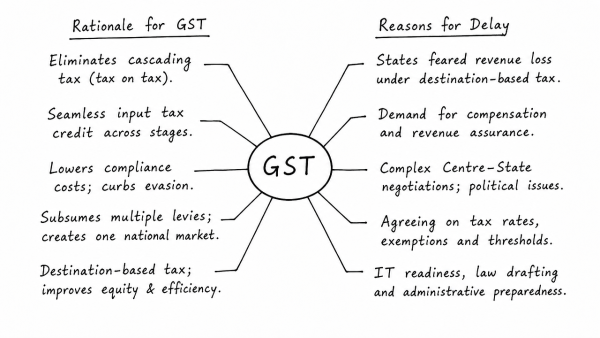
- Rationale: It removes cascading “tax on tax” through seamless input tax credit, lowers compliance costs, widens the tax base and curbs evasion.
- Market integration: By subsuming multiple central and state levies, it reduces interstate barriers and helps create one national market.
- Equity and efficiency: Tax accrues where goods/services are consumed, improving revenue fairness and reducing distortions.
The rollout was delayed mainly by federal and political concerns: states feared revenue loss under a destination-based tax, so compensation and rate-sharing had to be negotiated. Opposition over ceding taxing powers, exclusions for petroleum, alcohol and tobacco, and disputes on exemptions, threshold and rate structure slowed consensus. Administrative and technical readiness, including the GST Network and state-level adaptation, also took time.
Thus, GST was economically necessary, but its delayed implementation reflected the complexity of building cooperative federalism, not the weakness of the reform.
Originally written on
August 28, 2026
and last modified on
September 7, 2026.