Discuss the potential threats of Cyber attack and the security framework to prevent it. (UPSC 2017)
Cyber attacks now threaten privacy, public order, financial stability and even national security. India saw 29.44 lakh cyber incidents in 2025, showing how fast the risk is rising across government, education, banking and critical infrastructure.
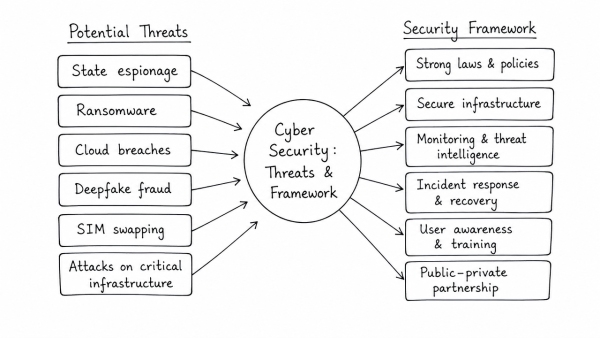
- Potential threats: state-sponsored espionage, ransomware, cloud breaches, deepfake-led fraud, SIM swapping, and attacks on power grids, telecom, satellites and smart cities.
- Economic impact: digital payment fraud can disrupt UPI trust, while attacks on databases can halt services and leak sensitive data.
- Human risk: phishing and AI-driven social engineering exploit poor cyber hygiene and weak passwords.
- Security framework: IT Act, 2000; DPDP Act, 2023; telecom security rules, 2024.
- Institutions: CERT-In for incident response, NCIIPC for critical infrastructure, NCCC for threat intelligence, I4C and 1930 helpline for cybercrime.
- Capacity: Cyber Commandos, CSIRTs, Cyber Swachhta Kendra and zero-trust architecture.
A resilient framework needs constant monitoring, trained manpower, secure design, quick reporting and public awareness. Cyber security must be treated as a core part of national security and governance.
Originally written on
August 31, 2026
and last modified on
August 31, 2026.