Discuss the possible factors that inhibit India from enacting for its citizens a uniform civil code as provided for in the Directive Principles of State Policy. (UPSC 2015)
India’s civil law is deeply plural, shaped by religion, region and custom. A uniform civil code is thus blocked less by law alone than by constitutional limits, social mistrust and political caution.
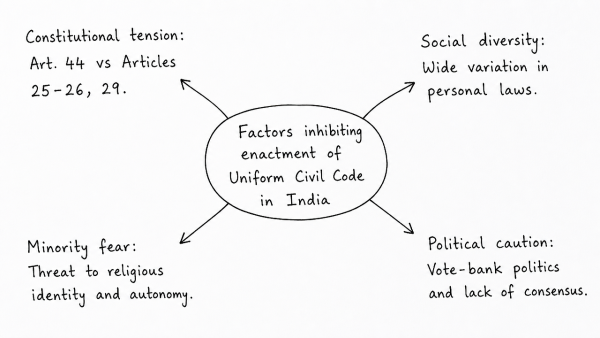
- Constitutional tension: Article 44 supports a UCC, but Articles 25-26 protect freedom of religion and denomination rights. Many see personal laws as part of cultural identity under Article 29.
- Social diversity: Marriage, inheritance, adoption and divorce rules differ widely across communities, making one code hard to frame without causing loss or resentment.
- Minority fear: A common code is often viewed as majoritarian uniformity rather than gender justice, reducing trust.
- Federal and tribal concerns: Family law is in the Concurrent List, while tribal and certain regional customs enjoy special protection under the Constitution.
- Political lack of consensus: Governments fear polarisation, and courts have only urged reform, not mandated legislation.
A practical path is gradual reform: remove discrimination in existing personal laws, protect customs where needed, and build broad consensus before any national code.
Originally written on
August 30, 2026
and last modified on
August 30, 2026.