Discuss the natural resource potentials of ‘Deccan Trap’. (UPSC 2022)
The Deccan Trap is one of India’s richest geological provinces. Its vast basaltic lava flows have created diverse soils, aquifers, mineral deposits and building materials, giving it high economic value.
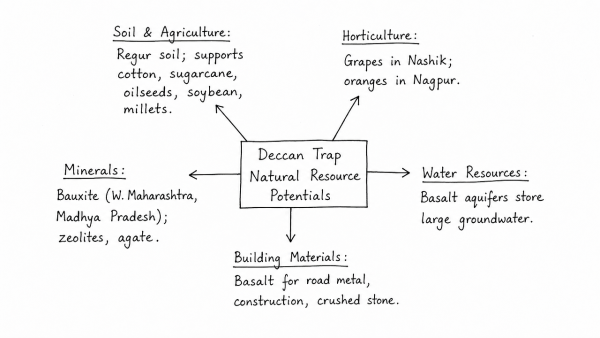
- Soil and agriculture: Weathered basalt forms regur or black cotton soil, rich in lime, iron and potash, and highly moisture-retentive. It supports cotton, sugarcane, oilseeds, soybean and millets.
- Horticulture: Shallow, well-drained slopes favour grapes in Nashik and oranges in Nagpur.
- Minerals: Intense weathering has produced bauxite in parts of western Maharashtra and Madhya Pradesh. Basalt cavities yield zeolites and semi-precious stones such as agate and amethyst.
- Construction material: Hard basalt is widely used as road metal, railway ballast and building stone.
- Water and energy: Joints and fractures in basalt create useful groundwater aquifers. The region also offers geothermal, wind and solar energy prospects.
Thus, the Deccan Trap is not just a volcanic landform but a major natural resource base for agriculture, minerals, water security and clean energy.
Originally written on
September 3, 2026
and last modified on
September 3, 2026.