Discuss the Namami Gange and National Mission for Clean Ganga (NMCG) programmes and causes of mixed results from the previous schemes. What quantum leaps can help preserve the river Ganga better than incremental inputs? (UPSC 2015)
Namami Gange is the flagship river-clean-up mission, and NMCG is its implementing arm. Together, they shifted Ganga management from a project-based approach to a basin-wide, mission mode effort with sewage treatment, industrial control, afforestation and public outreach.
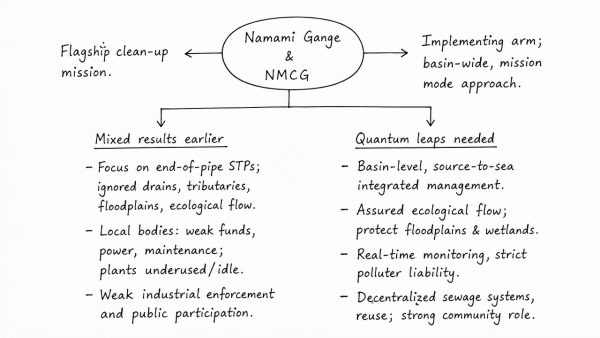
- Why earlier schemes gave mixed results: Ganga Action Plans relied too much on end-of-pipe sewage plants.
- They ignored drains, tributaries, floodplains and ecological flow, so pollution kept re-entering the river.
- Local bodies lacked funds, power and maintenance capacity; many plants were underused or idle.
- Industrial enforcement and public participation were weak.
- Quantum leaps needed: basin-wide planning with strict river ecology protection.
- Assured environmental flows, floodplain zoning and control of polluting tributaries.
- Decentralised sewage treatment, real-time monitoring, and automatic action against violators.
- Arth Ganga should link clean Ganga to livelihoods, organic farming, treated water reuse and community stewardship.
Thus, the river needs a shift from scattered infrastructure spending to integrated governance, ecology and local ownership. Only such systemic change can make Ganga restoration durable.
Originally written on
August 30, 2026
and last modified on
August 30, 2026.