Discuss the multi-dimensional implications of uneven distribution of mineral oil in the world. (UPSC 2021)
Uneven distribution of mineral oil has made it a strategic resource, not merely a commodity. A few regions and countries control most proven reserves, while many industrial economies depend heavily on imports. This asymmetry shapes prices, power, trade and security across the world.
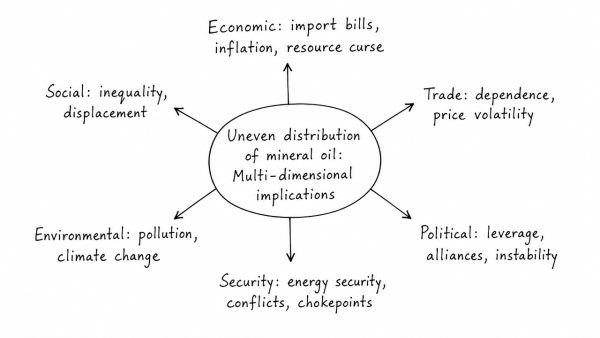
- Economic effects: Oil-importing countries face large import bills, current account deficits and pressure on foreign exchange reserves. Rising crude prices transmit inflation to transport, fertiliser and food costs, slowing growth. Oil-rich states may gain windfall revenues, but overdependence often creates the resource curse and weakens diversification.
- Trade and market power: Concentration of reserves gives exporters, especially within OPEC and OPEC+, influence over supply and price. Producing countries can use production cuts as leverage, while importing countries are exposed to volatility and cartel behaviour.
- Strategic and geopolitical effects: Major oil trade passes through narrow chokepoints such as the Strait of Hormuz, making supply chains vulnerable to conflict, sanctions and piracy. Energy security therefore becomes central to foreign policy, defence planning and strategic stockpiling.
- Technological impact: Resource imbalance has encouraged innovation in shale oil, deepwater drilling, enhanced recovery and strategic petroleum reserves. It has also pushed importing countries to diversify suppliers and build alternative energy capacity.
- Environmental and social costs: Oil-rich regions often suffer pollution, spills, gas flaring and ecological damage. At the same time, labour migration to oil-exporting states creates remittance flows, but also dependence on unstable regional economies.
Thus, the uneven distribution of mineral oil creates a chain of economic dependence, geopolitical competition, technological adaptation and environmental stress. It remains a key driver of global power relations and the transition towards cleaner and more secure energy systems.
Originally written on
September 2, 2026
and last modified on
September 2, 2026.