Discuss the main objectives of Population Education and point out the measures to achieve them in India in detail. (UPSC 2021)
Population education seeks to build informed, responsible citizens who understand the links between population, development, health and environment. In India, it is important because fertility varies widely across regions and demographic gains can be lost without awareness and planning.
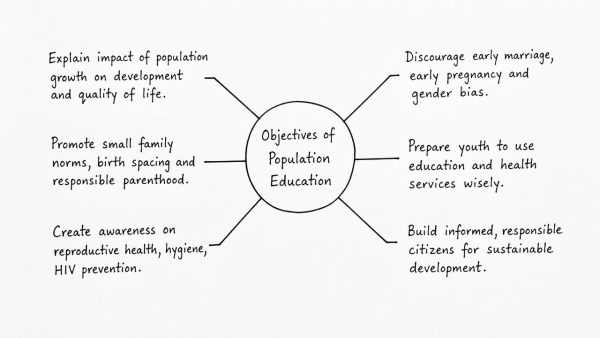
- Objectives
- Explain the effects of population growth on poverty, employment, resources, housing and quality of life.
- Promote small family norms, birth spacing and responsible parenthood.
- Create awareness on reproductive and sexual health, hygiene, HIV prevention and adolescent well-being.
- Discourage early marriage, early pregnancy and gender bias.
- Prepare youth to use education and skills for the demographic dividend.
- Measures
- Integrate population education into school and college curricula through age-appropriate, locally relevant modules.
- Train teachers, counsellors and health workers to handle sensitive issues with accuracy and confidence.
- Strengthen adolescent education through school health programmes, peer groups, counselling, and menstrual and nutrition awareness.
- Expand community outreach through ASHAs, anganwadi workers, local campaigns and support for parents, out-of-school youth and newly married couples.
- Ensure easy access to contraception, family planning counselling, spacing methods and male participation, especially in high-fertility districts.
- Use media, digital platforms and local-language campaigns to spread awareness on child marriage, girls’ education and reproductive rights.
Thus, population education must combine knowledge, attitudes and practices through schools, communities and public health support to promote health, equality and responsible family life.
Originally written on
September 2, 2026
and last modified on
September 2, 2026.