Discuss the essentials of the 69th Constitutional Amendment Act and anomalies, if any, that have led to recent reported conflicts between the elected representatives and the institution of the Lieutenant Governor in the administration of Delhi. Do you think that this will give rise to a new trend in the functioning of the Indian federal politics? (UPSC 2015)
The 69th Constitutional Amendment Act, 1991 gave Delhi a special constitutional status as the National Capital Territory through Articles 239AA and 239AB, creating an elected Assembly and Council of Ministers with limited powers.
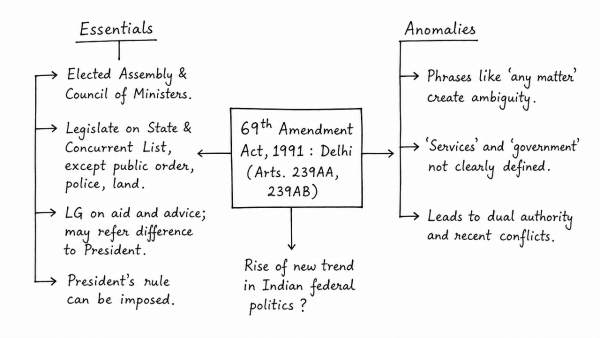
- Essentials: Delhi can legislate on State and Concurrent List subjects, except public order, police and land; the Lieutenant Governor acts on aid and advice, but may refer a difference to the President; President’s rule can be imposed if needed.
- Anomalies: Phrases like “any matter” and the ambiguity over “services” and “government” have enabled dual authority, especially over bureaucracy, producing conflicts between the elected government and the LG.
These disputes point to a more centralised, contested federalism in Union Territories, but Delhi’s special national-capital status makes it an exception rather than a new general trend in Indian federal politics.
Originally written on
August 30, 2026
and last modified on
August 30, 2026.