Discuss the essential conditions for exercise of the legislative powers by the Governor. Discuss the legality of re-promulgation of ordinances by the Governor without placing them before the Legislature. (UPSC 2022)
The Governor’s ordinance-making power is an extraordinary legislative power meant for urgent situations when the State Legislature is not able to act. It is not a parallel law-making authority, and its use is tightly controlled by constitutional limits.
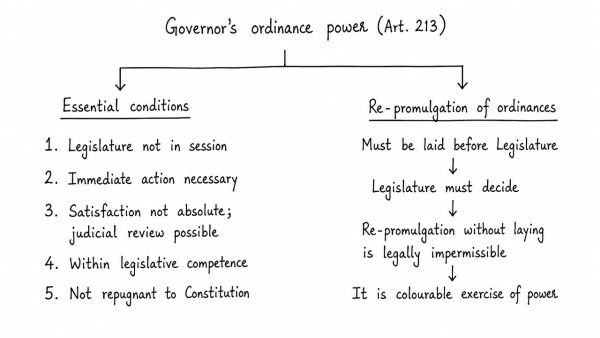
- Essential conditions under Article 213
- The Legislature must be not in session; the power exists only during recess.
- The Governor must be satisfied that immediate action is necessary. This satisfaction is not absolute and can be examined by courts for mala fides or colourable exercise of power.
- The ordinance must be within the same legislative field as an Act of the State Legislature and cannot violate the Constitution or Fundamental Rights.
- Where a similar Bill would need the President’s prior sanction, the Governor can issue an ordinance only after President’s instructions.
- Every ordinance must be laid before the Legislature when it reassembles and will cease after six weeks unless approved earlier by an Act or disapproved by the House.
- Legality of re-promulgation
- Repeated re-issue of the same ordinance without placing it before the Legislature is unconstitutional.
- It defeats legislative scrutiny, weakens democratic accountability and converts an emergency power into a routine device.
- In D.C. Wadhwa and later Krishna Kumar Singh, the Supreme Court held that re-promulgation is a fraud on the Constitution and a colourable exercise of power.
- Ordinances are temporary measures; rights and liabilities created by them do not automatically survive their lapse unless supported by valid legislation.
Thus, the Governor may legislate by ordinance only in genuine urgency and within strict constitutional limits. Re-promulgation without legislative approval is illegal and contrary to parliamentary democracy.
Originally written on
September 3, 2026
and last modified on
September 3, 2026.