Discuss the concept of air mass and explain its role in macro-climatic changes. (UPSC 2016)
An air mass is a vast body of air, extending over thousands of square kilometres, with fairly uniform temperature and moisture. It forms over a source region such as oceans, deserts or ice sheets, where light winds allow it to take on surface characteristics.
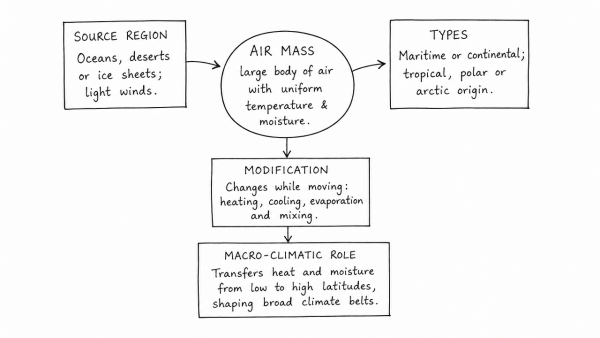
- Types: It may be maritime or continental, and tropical, polar or arctic in origin.
- Modification: While moving, it changes through heating, cooling, evaporation and mixing with other air masses.
- Macro-climatic role: Air masses transfer heat and moisture from low to high latitudes, shaping broad climate belts.
- Fronts and storms: Meeting of different air masses creates fronts, which generate mid-latitude cyclones and rainfall.
- Seasonal shifts: Their movement helps explain monsoons, heat waves, cold waves and dry or wet spells.
Thus, air masses are major controls of regional climate. Their dominance, movement and interaction explain large-scale climatic variations across the globe.
Originally written on
August 30, 2026
and last modified on
August 30, 2026.