Discuss the changes in the trends of labour migration within and outside India in the last four decades. (UPSC 2015)
Labour migration in India has become larger, more mobile and more diversified over the last four decades, shifting from mainly distress-driven, male and permanent movement to circular, skill-linked and multi-destination flows.
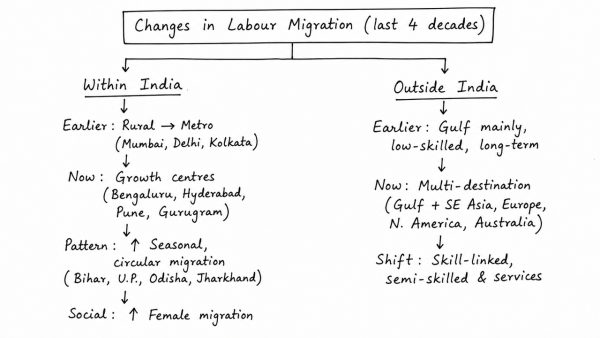
- Within India: Earlier migration was largely from rural areas to metros like Mumbai, Delhi and Kolkata. Now it also targets growth centres such as Bengaluru, Hyderabad, Pune and Gurugram.
- Pattern: Seasonal and circular migration has risen, especially among informal workers from Bihar, Uttar Pradesh, Odisha and Jharkhand. COVID-19 exposed their vulnerability through large reverse migration.
- Social dimension: Female migration has increased for work and education, though marriage remains important.
- Outside India: Overseas migration has moved beyond low-skilled Gulf jobs to nursing, services, IT and higher education-led mobility to the US, UK, Canada and Australia. Northern states now contribute more, alongside southern states.
Overall, labour migration has shifted from a narrow one-way flow to a flexible, multi-directional and policy-sensitive process needing stronger social security and portable rights.
Originally written on
August 29, 2026
and last modified on
August 29, 2026.