Discuss the causes of the depletion of mangroves and explain their importance in maintaining coastal ecology. (UPSC 2019)
Mangroves are among the most productive coastal ecosystems, yet they are steadily shrinking due to human pressure and climate stress. In India, the mangrove cover is about 4,991.68 sq. km, showing that protection and restoration remain urgent.
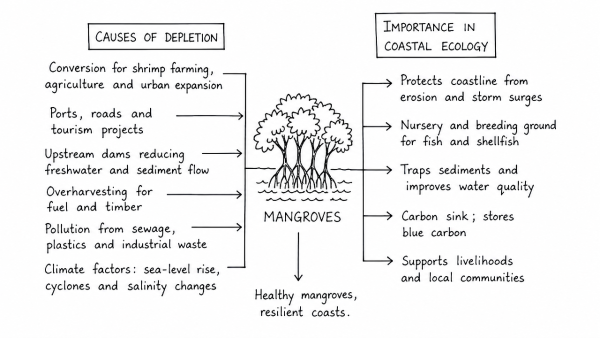
- Causes of depletion: conversion for shrimp farming, agriculture and urban expansion; ports, roads and tourism projects; upstream dams reducing freshwater and sediment flow; overharvesting for fuel and timber; pollution from sewage, plastics and industrial waste.
- Climate factors: sea-level rise, coastal squeeze, cyclones and salinity changes weaken regeneration and drown roots.
- Importance in coastal ecology: they act as natural bio-shields, absorbing wave energy and reducing cyclone damage.
- Their roots trap sediments, check erosion and help build shoreline stability.
- They store large amounts of carbon, support fish breeding and serve as nurseries for marine life.
- They also filter pollutants and protect coral reefs and seagrass beds.
Thus, mangroves are vital for both ecological balance and coastal livelihoods; their conservation must be a priority in climate adaptation and coastal planning.
Originally written on
September 1, 2026
and last modified on
September 1, 2026.