Discuss the advantages and security implications of cloud hosting of servers vis-a-vis in-house machine-based hosting for government businesses. (UPSC 2015)
Cloud hosting offers governments flexibility, faster service delivery and lower upfront costs compared with in-house server rooms. Yet it also raises concerns over data control, cyber risks and vendor dependence, so the choice must be guided by sensitivity of data and service criticality.
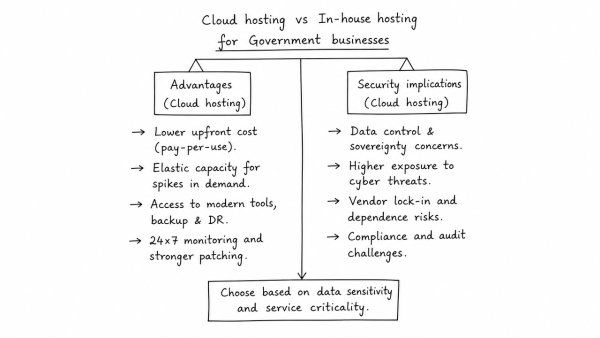
- Advantages: Pay-per-use model reduces capital spending on hardware, cooling and upkeep.
- Elastic capacity handles sudden traffic on portals like recruitment, welfare and citizen-service platforms.
- It avoids rapid obsolescence and gives access to modern tools, backup and disaster recovery.
- Large providers can offer 24×7 monitoring and stronger patch management than many departments can maintain.
- Security implications: Security becomes a shared responsibility; weak configuration can expose data.
- Data residency and privacy need strict compliance, encryption and audit controls.
- For defence, intelligence and highly sensitive records, in-house or air-gapped hosting may remain safer.
Thus, cloud hosting suits most government businesses, especially public-facing services, but should be adopted with robust contracts, localisation, continuous audits and a hybrid model for sensitive workloads.
Originally written on
August 30, 2026
and last modified on
August 30, 2026.