Discuss India’s achievements in the field of Space Science and Technology. How has the application of this technology helped India in its socio-economic development? (UPSC 2016)
India has emerged as a leading space power with achievements in science, technology and policy. Chandrayaan-3 made India the first country to achieve a soft landing near the Moon’s south pole; Aditya-L1 placed a solar observatory at L1; XPoSat advanced studies of high-energy astrophysics. SpaDeX demonstrated autonomous docking, while SSLV and RLV tests marked progress in low-cost and reusable launch systems. Indian Space Policy 2023, IN-SPACe and NSIL have also opened the sector to private enterprise and foreign investment.
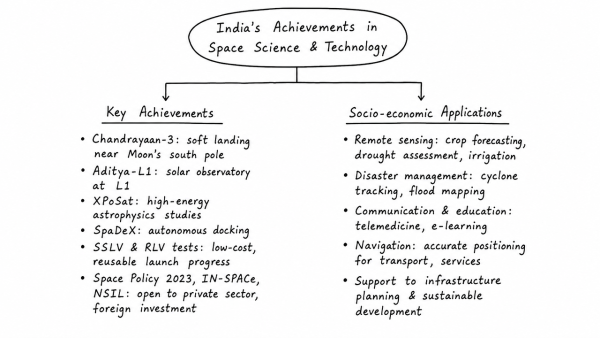
- Socio-economic use: Remote sensing aids crop forecasting, drought assessment, irrigation and mineral mapping; satellite data supports weather prediction, disaster warning, forest-fire monitoring and resource management.
- Governance and services: Satellite communication enables tele-education, telemedicine, digital connectivity, land-use planning and rural outreach, while NavIC improves navigation, maritime safety and transport efficiency.
- Growth and security: Space applications create skilled employment, promote start-ups, strengthen strategic autonomy and attract investment.
Thus, India’s space programme is both a symbol of scientific excellence and a practical instrument for inclusive socio-economic development.
Originally written on
August 31, 2026
and last modified on
August 31, 2026.