Discuss in the light of global supply chain disruptions why “silicon diplomacy” has become central to bilateral partnerships. How can India leverage its design talent geopolitically?
Global supply-chain shocks have shown that semiconductors are strategic assets, not mere industrial inputs. With design, equipment, materials and fabrication concentrated in a few countries, disruption can hit autos, telecom, defence and digital services.
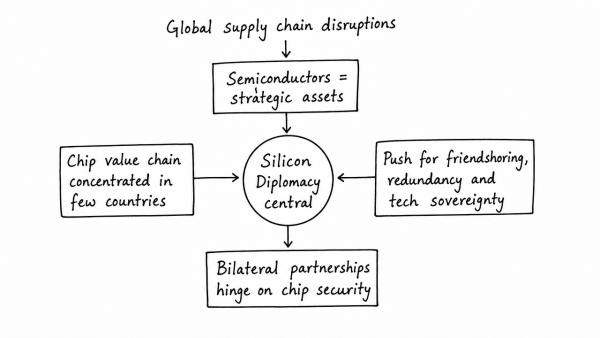
- Why silicon diplomacy matters
The chip value chain is chokepoint-driven: the US leads in EDA software, the Netherlands in lithography, Japan in key chemicals, while Taiwan and China dominate advanced fabrication and refining of critical minerals. This has pushed states towards friendshoring, redundancy and technological sovereignty. - Why bilateral partnerships hinge on chips
Semiconductor security now shapes trade, defence and tech ties. Countries seek trusted partners for resilient supply chains, co-development, market access and insulation from coercion; hence chip cooperation is central to bilateral and minilateral groupings. - India’s geopolitical leverage
India has a deep chip-design talent pool and global firms already run design centres here. It can move from services to IP ownership through design-linked incentives, startup support, wider EDA access, RISC-V and AI-chip IP, secure chips for defence/telecom/space, and trusted design partnerships with the US, EU, Japan and Singapore.
By becoming a design hub, India can create allied dependencies, secure better technology terms and strengthen its role in Indo-Pacific supply-chain resilience.
Originally written on
September 9, 2026
and last modified on
September 9, 2026.