Discuss in the light of Article 262, how federal friction persists despite the existence of judicial and statutory mechanisms for resolving inter-state river disputes.
Article 262 was meant to reduce conflict by allowing Parliament to create a special framework for inter-state river water disputes and, if needed, bar ordinary court jurisdiction. Yet, federal friction continues because the legal machinery has not matched the political and administrative realities of water scarcity.
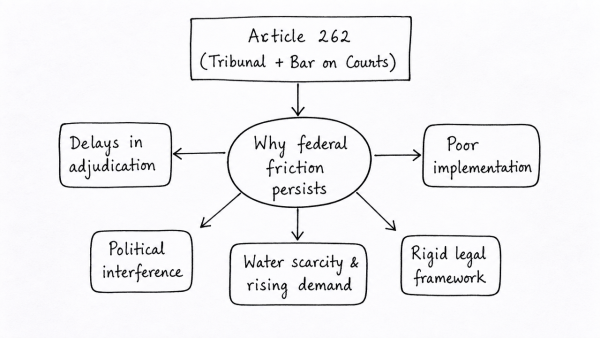
Why friction persists
- Delays in adjudication: Tribunals are often set up late, work for years, and give awards after long gaps. This weakens confidence in the system and allows disputes to harden.
- Poor implementation: Even after awards, states may delay or resist compliance. There is no strong, independent enforcement mechanism.
- Judicial overlap: Though Article 262 seeks to limit court intervention, disputes still reach the Supreme Court through constitutional routes, creating confusion over final authority.
- Political mobilisation: Water disputes are easily turned into identity and electoral issues. This reduces room for compromise and makes technical solutions politically costly.
- Data disputes: States contest flow measurements, storage levels, and projected needs. In the absence of trusted real-time data, every claim becomes politically charged.
- Rising scarcity: Growing demand, erratic monsoons, droughts, and climate stress intensify competition and make allocation more contentious.
Limits of the existing framework
- The Inter-State River Water Disputes Act, 1956 relies on ad hoc tribunals, which are slow and fragmented.
- The River Boards Act, 1956 has not been effectively used for cooperative basin management.
- Proposed reforms such as a permanent tribunal and pre-litigation negotiation are useful, but their impact depends on political will.
Thus, Article 262 provides a constitutional route, but not a complete solution. Federal friction persists because river water disputes are not only legal conflicts; they are also questions of trust, power, data, and resource stress.
Originally written on
September 14, 2026
and last modified on
September 14, 2026.