Discuss in detail the photochemical smog emphasizing its formation, effects and mitigation. Explain the 1999 Gothenburg Protocol. (UPSC 2022)
Photochemical smog is a brownish, oxidising haze seen in warm, sunny, dry cities with heavy traffic and industry.
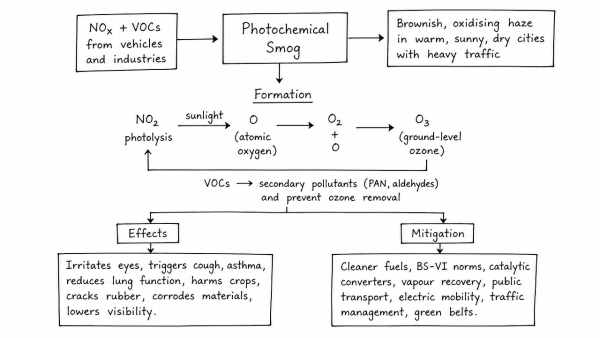
- Formation: NOx and VOCs from vehicles and industries react under sunlight; NO2 photolyses to form atomic oxygen, which produces ground-level ozone. VOCs generate secondary pollutants like PAN and aldehydes and prevent ozone removal.
- Effects and mitigation: It irritates eyes, triggers cough, asthma and reduced lung function, harms crops, cracks rubber, corrodes materials and lowers visibility; control needs cleaner fuels, BS-VI norms, catalytic converters, vapour recovery, public transport, electric mobility, traffic management and strict NOx/VOC regulation.
The 1999 Gothenburg Protocol under UNECE-LRTAP fixed binding emission ceilings for SO2, NOx, VOCs and NH3 to curb acidification, eutrophication and ozone pollution, and was later strengthened to include PM2.5.
Originally written on
September 3, 2026
and last modified on
September 3, 2026.