Discuss how emerging technologies and globalisation contribute to money laundering. Elaborate measures to tackle the problem of money laundering both at national and international levels. (UPSC 2021)
Money laundering disguises illicit income as lawful wealth; emerging technologies and globalisation have made it faster, more anonymous and harder to trace.
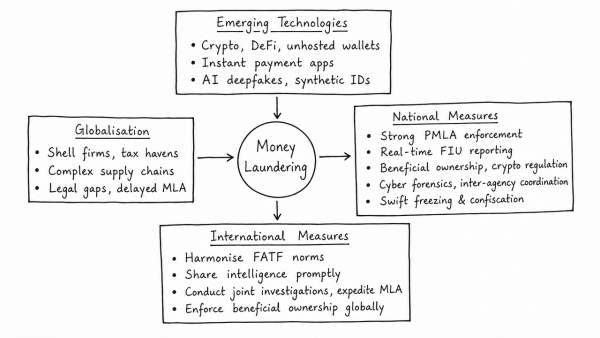
Drivers: Crypto assets, DeFi, unhosted wallets, instant payment apps, AI-generated deepfakes and synthetic identities weaken KYC. Global trade, shell firms, tax havens and complex supply chains enable layering across borders, while legal gaps and delayed mutual legal assistance aid criminals.
Measures: Nationally, strengthen PMLA enforcement, real-time FIU reporting, beneficial ownership disclosure, crypto regulation, cyber forensics, inter-agency coordination and swift freezing/confiscation. Internationally, harmonise FATF norms, share intelligence promptly, conduct joint investigations, regulate virtual assets uniformly, curb tax havens, and expedite extradition and asset recovery.
Technology-led monitoring, legal reform and sustained global cooperation are essential to disrupt laundering networks while preserving legitimate financial flows.