Discuss about the vulnerability of India to earthquake related hazards. Give examples including the salient features of major disasters caused by earthquakes in different parts of India during the last three decades. (UPSC 2021)
India is highly vulnerable to earthquake-related hazards because it lies on active plate boundaries and also suffers from intraplate shocks. About 59% of the landmass faces moderate to severe risk, while the Himalayas, the Indo-Gangetic plains, the North-East, Kutch and the Andaman-Nicobar region remain especially exposed.
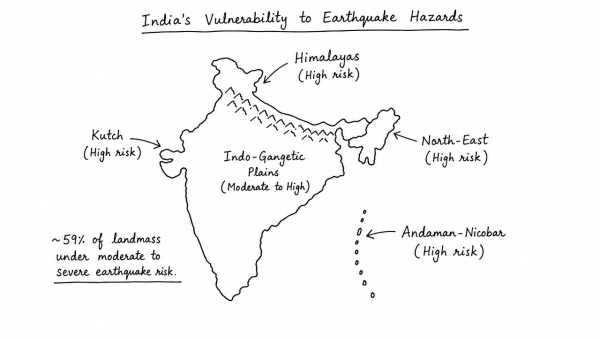
- Tectonic causes: Collision of the Indian and Eurasian plates, active faults such as the Main Central Thrust, and subduction near the Sunda Trench.
- Secondary hazards: Landslides, liquefaction, dam failures and tsunamis worsen losses.
- Human factors: Dense population, weak masonry, hill settlement and unplanned urban growth increase casualties.
- Jabalpur, 1997: Showed intraplate risk in central India and the weakness of non-engineered houses.
- Bhuj, 2001: Caused over 13,000 deaths, wide liquefaction and collapse of about 4 lakh homes.
- J&K, 2005 and Chamoli, 1999: Triggered massive landslides and destruction in steep mountain terrain.
- 2004 tsunami: Undersea quake devastated Andaman-Nicobar and the east coast.
Thus, India needs strict seismic codes, safer construction and better preparedness to reduce future losses.
Originally written on
September 3, 2026
and last modified on
September 3, 2026.