Differentiate the causes of landslides in the Himalayan region and Western Ghats. (UPSC 2021)
The Himalayan region and the Western Ghats both face landslides, but the causes differ because of their geology, relief and rainfall pattern. In the Himalayas, landslides are mainly linked to young and tectonically active mountains, while in the Western Ghats they are driven more by weathering, slope saturation and human disturbance.
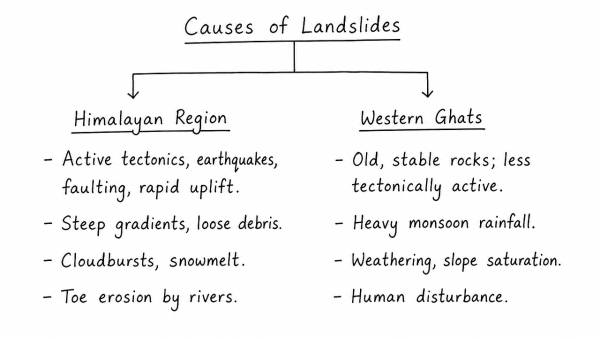
- Himalayas: Active tectonics, frequent earthquakes, faulting and rapid uplift weaken slopes. Steep gradients, loose debris, cloudbursts, snowmelt and toe erosion by rivers trigger slides and rockfalls.
- Western Ghats: Old and stable basaltic and metamorphic rocks are less tectonically active, but deep weathering, joints and shear zones create failure planes. Prolonged monsoon rain saturates laterite and clay-rich soils, raising pore pressure.
- Human factors: In the Himalayas, road cutting, hydropower projects and unplanned urban growth are major causes. In the Western Ghats, quarrying, plantation changes, resort building and slope cutting matter more.
Thus, Himalayan landslides are largely tectono-climatic, whereas Western Ghats landslides are mainly rain-induced on deeply weathered, human-disturbed slopes.
Originally written on
September 2, 2026
and last modified on
September 2, 2026.