Despite India being one of the countries of the Gondwanaland, its mining industry contributes much less to its Gross Domestic Product (GDP) in percentage. Discuss. (UPSC 2021)
India inherited rich mineral endowments from the Gondwanaland break-up, yet mining adds only about 2% to GDP. This is because mineral wealth has not been converted into high-value output on a large scale.
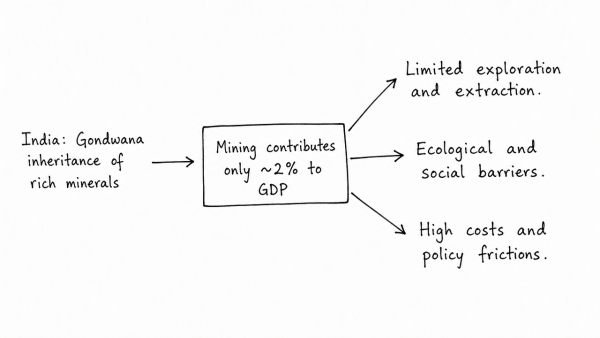
- Limited exploration and extraction: Only a small part of India’s geological potential has been explored. Deep-seated minerals, offshore resources and critical minerals remain underdeveloped.
- Ecological and social barriers: Many deposits lie in forests, tribal areas and sensitive zones, causing land acquisition issues, delays in clearance and local opposition.
- High costs and policy frictions: Multiple levies, royalties, auction premiums and transit fees raise the cost of mining and reduce competitiveness.
- Low technology and value addition: Dependence on open-cast methods, weak mechanisation and poor mineral processing limit productivity and export value.
Thus, India has the geological base but not the ecosystem for large mining-led growth. Faster exploration, better governance, cleaner technology and stronger mineral processing are needed to raise mining’s share in GDP.
Originally written on
September 2, 2026
and last modified on
September 2, 2026.