‘Despite implementation of various programmes for eradication of poverty by the government in India, poverty is still existing.’ Explain by giving reasons. (UPSC 2018)
Poverty has declined sharply in India, yet it has not disappeared. The fall in multidimensional poverty shows progress, but many households still face low incomes, poor nutrition, weak services and job insecurity.
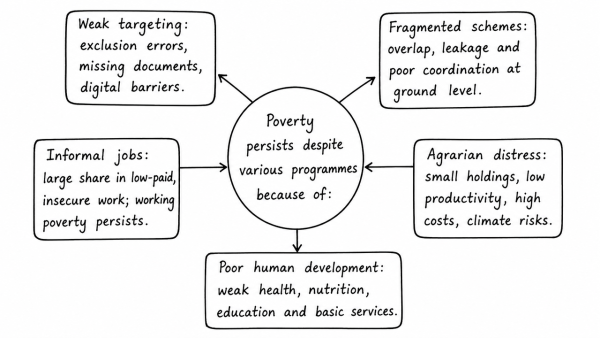
- Weak targeting: exclusion errors, missing documents and digital barriers leave out eligible families, especially migrants, tribals and the homeless.
- Fragmented schemes: many programmes work in silos, causing overlap, leakage and poor coordination at ground level.
- Informal jobs: a large share of workers remain in low-paid, insecure informal employment, so poverty persists as “working poverty”.
- Agrarian distress: small holdings, low productivity, climate shocks and underemployment keep rural households vulnerable.
- Human capital deficits: poor education, malnutrition and high health spending trap families across generations.
- Social inequality: caste, gender and regional deprivation restrict access to land, credit, skills and decent jobs.
Thus, poverty in India is not only a lack of income but also a lack of opportunity, security and capabilities. Sustainable reduction needs better targeting, quality jobs, stronger public services and climate-resilient growth.
Originally written on
August 31, 2026
and last modified on
August 31, 2026.