Describing the distribution of rubber producing countries, indicate the major environmental issues faced by them. (UPSC 2022)
Natural rubber production is concentrated mainly in the humid tropics, where temperature, rainfall and soil conditions suit Hevea brasiliensis. The largest producers are in Southeast Asia, followed by parts of South Asia, China and West Africa; traditional production in South America is now very small.
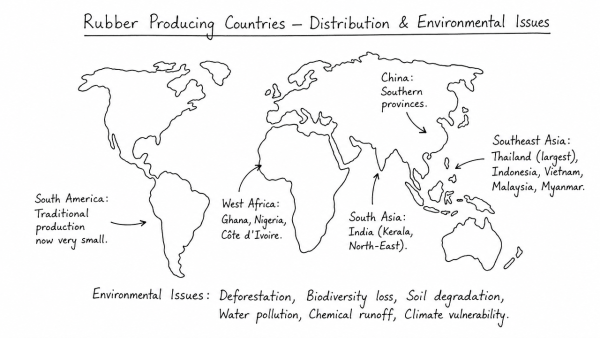
- Southeast Asia: Thailand, Indonesia, Vietnam, Malaysia and Myanmar dominate global output. Thailand is the largest producer, while Indonesia and Vietnam are also major exporters.
- South Asia: India is a significant producer, with Kerala as the main centre and expansion in the North-East.
- East Asia: Southern China, especially Hainan and Yunnan, has important plantations.
- Africa: Côte d’Ivoire, Liberia and neighbouring states are rising producers.
- South America: Brazil, the crop’s original home, contributes little today.
Major environmental issues faced
- Deforestation and biodiversity loss: Rubber expansion often replaces natural forests, especially in the Mekong region, causing habitat fragmentation and loss of wildlife.
- Monoculture risk: Large single-crop plantations reduce ecological diversity and increase vulnerability to pests and diseases.
- Soil degradation: Repeated tapping, clearing of forest cover and plantation on slopes can lead to nutrient loss, erosion and landslides.
- Water pollution: Rubber processing generates acidic effluents with high organic load, which pollute rivers and harm aquatic life if untreated.
- Climate stress: Droughts, erratic rainfall and rising temperatures affect latex flow, yield and plantation health.
- Compliance pressure: Deforestation-free supply rules are increasing costs for smallholders and plantation states.
Thus, rubber-producing countries face a difficult balance between export earnings and environmental sustainability. The way forward lies in diversified agroforestry, stricter waste treatment, soil conservation and traceable, deforestation-free supply chains.
Originally written on
September 3, 2026
and last modified on
September 3, 2026.