Describe various measures taken in India for Disaster Risk Reduction (DRR) before and after signing ‘Sendai Framework for DRR (2015-2030)’. How is this framework different from ‘Hyogo Framework for Action, 2005’? (UPSC 2018)
India’s disaster risk reduction approach has moved from relief after calamity to prevention, preparedness and resilience. The shift became more systematic with new institutions, laws, funds, early warning systems and community participation.
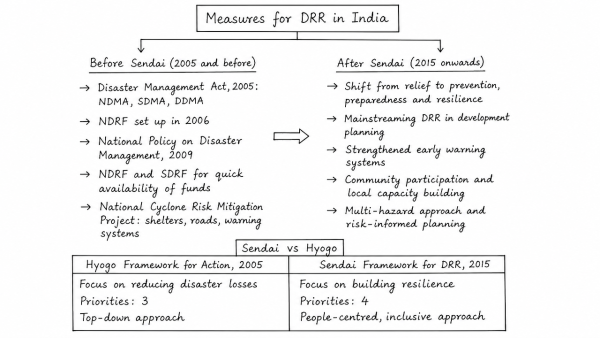
- Before Sendai Framework
- Disaster Management Act, 2005 created a three-tier system: NDMA, SDMA and DDMA.
- NDRF was set up in 2006 as a trained multi-hazard response force.
- National Policy on Disaster Management, 2009 mainstreamed DRR into development planning.
- NDRF and SDRF ensured quick availability of response funds.
- National Cyclone Risk Mitigation Project strengthened shelters, roads and warning systems in coastal areas.
- IMD, CWC and INCOIS expanded early warning for cyclones, floods and tsunamis.
- After Sendai Framework, 2015-2030
- National Disaster Management Plan, 2016, revised in 2019, aligned India with Sendai, SDGs and Paris Agreement.
- Prime Minister’s 10-Point Agenda stressed risk-informed development, local capacity and women’s role.
- CDRI was launched in 2019 to promote resilient infrastructure.
- Sachet, CAP-based alerts and sectoral warning apps improved last-mile communication.
- Aapda Mitra trained community volunteers as first responders.
- 15th Finance Commission created mitigation funds, giving resources for risk reduction, not only relief.
| Hyogo Framework | Sendai Framework |
| Focus on managing disasters and reducing vulnerability. | Focus on managing risk, preventing new risk, and building resilience. |
| Mainly natural hazards. | Broader coverage: natural, technological, biological and environmental hazards. |
| No clear global numerical targets. | Seven measurable global targets and indicators. |
| State-led approach. | Shared responsibility with local bodies, communities and private sector. |
Thus, India’s DRR framework has become more integrated, data-driven and participatory. Sendai is superior to Hyogo because it treats disaster risk as a development issue and links prevention, preparedness, response and recovery in one continuum.
Originally written on
September 1, 2026
and last modified on
September 1, 2026.