Describe the various causes and the effects of landslides. Mention the important components of the National Landslide Risk Management Strategy. (UPSC 2021)
Landslides are rapid downslope movements of rock, debris or soil under gravity. In India, they are common in the Himalayas, North-East, Western Ghats and other steep hill regions, and are often triggered by a mix of natural and human causes.
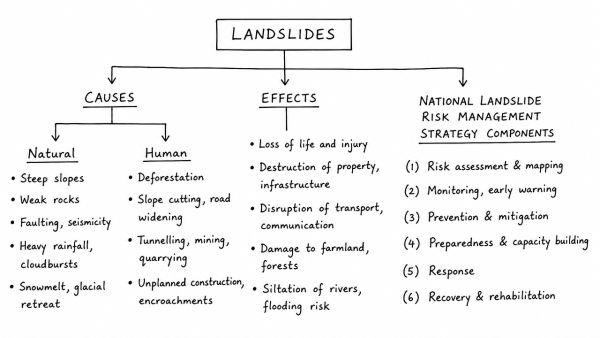
- Natural causes: steep slopes, weak or weathered rocks, faulting, seismic activity, heavy rainfall, cloudbursts, snowmelt and glacial retreat raise slope instability.
- Hydrological triggers: intense rain saturates soil, increases pore-water pressure and reduces friction, causing slope failure.
- Human causes: deforestation, slope cutting, unplanned road widening, tunnelling, mining, quarrying, unregulated construction and poor drainage weaken hillsides. Shifting cultivation and lack of terracing also increase erosion.
| Effects | Impact |
| Human | Deaths, injuries, displacement and loss of livelihoods |
| Economic | Damage to homes, farms, roads, railways, hydropower and tourism; high relief and repair costs |
| Environmental | Soil erosion, forest loss, habitat destruction and river siltation |
| Secondary hazards | Blocked rivers, landslide-dammed lakes and flash floods |
Important components of the National Landslide Risk Management Strategy include:
- hazard and susceptibility mapping at suitable scales;
- landslide monitoring and early warning systems using rainfall thresholds and sensors;
- community awareness and public education;
- capacity building of engineers, administrators and local responders;
- mountain-specific land-use rules, building bye-laws and zoning;
- structural and bio-engineering mitigation, with dedicated research support.
Thus, landslide risk needs both prevention and preparedness. Scientific mapping, safer hill development and community-based warning systems are essential to reduce losses in vulnerable mountain regions.
Originally written on
September 3, 2026
and last modified on
September 3, 2026.