Describe the key points of the revised Global Air Quality Guidelines (AQGs) recently released by the World Health Organisation (WHO). How are these different from its last update in 2005? What changes in India’s National Clean Air Programme are required to achieve these revised standards? (UPSC 2021)
The WHO’s revised Air Quality Guidelines set much tougher health-based limits for six pollutants: PM2.5, PM10, ozone, nitrogen dioxide, sulfur dioxide and carbon monoxide. They stress that no safe level of air pollution exists and add interim targets and good-practice advice for particles such as black carbon and dust.
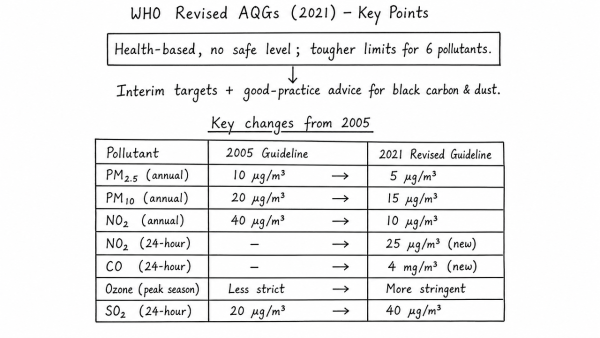
- Main changes from 2005: PM2.5 annual limit fell from 10 to 5 µg/m³; PM10 from 20 to 15; NO2 from 40 to 10. New 24-hour limits were added for NO2 and CO, while ozone guidance became stricter for peak-season exposure.
- Policy meaning: The revised limits are far more health-protective and reflect newer evidence on premature death, heart disease, stroke and poor child health at lower pollution levels.
- For NCAP: India must shift from city-wise, PM10-led control to airshed planning, stronger PM2.5 targets, better monitoring, and tighter action on transport, industry, power plants, waste burning and road dust.
NCAP should also align national ambient standards progressively with WHO interim targets, backed by time-bound funding, compliance and public health tracking.
Originally written on
September 3, 2026
and last modified on
September 3, 2026.