Describe the characteristics and types of primary rocks. (UPSC 2022)
Primary rocks are the first-formed rocks of the Earth, created by the cooling and solidification of magma or lava. They make up much of the crust and act as the parent material for other rock types.
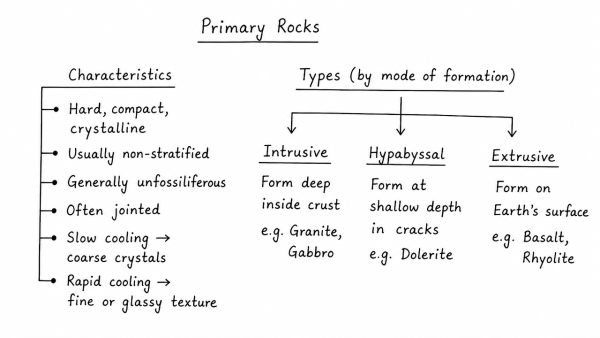
- Characteristics: hard, compact and crystalline; usually non-stratified; generally unfossiliferous; and often jointed. Slow cooling gives coarse crystals, while rapid cooling gives fine-grained or glassy texture.
- By mode of formation: intrusive rocks form deep inside the crust, such as granite and gabbro; hypabyssal rocks form at shallow depth in cracks, such as dolerite; extrusive rocks form on the surface, such as basalt, rhyolite, pumice and obsidian.
- By silica content: acidic rocks are light-coloured and silica-rich, e.g., granite; basic rocks are dark and silica-poor, e.g., basalt; intermediate and ultrabasic types also occur.
Thus, primary rocks are vital for landforms, soils and minerals, and their type depends mainly on place of cooling and chemical composition.
Originally written on
September 3, 2026
and last modified on
September 3, 2026.