Describe any four cultural elements of diversity in India and rate their relative significance in building a national identity. (UPSC 2015)
India’s national identity is built not by uniformity but by unity in diversity. Its cultural plurality gives citizens multiple loyalties that can coexist within one constitutional framework. Four key elements are language, religion, regional art and heritage, and tribal culture.
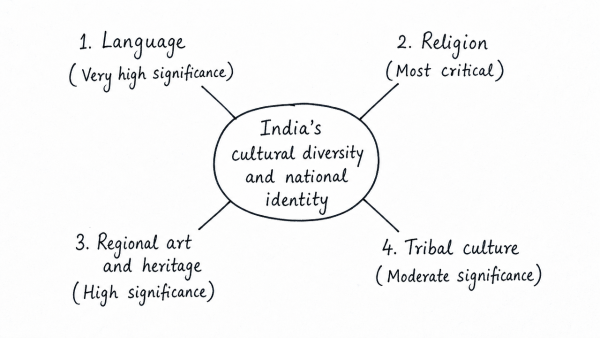
- Language: With 22 scheduled languages and 11 classical languages, linguistic diversity is very high significance. It sustains federalism and makes national identity inclusive.
- Religion: India’s plural faith traditions and secular Constitution make religious diversity the most critical. Equal respect for all faiths protects civic nationalism.
- Regional art, festivals and heritage: Temples, monuments, dance, music and festivals create a shared civilisational memory. Their significance is high in giving emotional unity.
- Tribal culture: Distinct customs, languages and community life enrich ecological and social values. Its significance is high for an equitable, representative nation.
Thus, all four are important, but religion and language are most vital, as they directly shape citizenship, cohesion and the idea of India as a plural, democratic nation.
Originally written on
August 29, 2026
and last modified on
August 29, 2026.