Defining blue revolution, explain the problems and strategies for pisciculture development in India. (UPSC 2018)
Blue revolution refers to the rapid and sustainable growth of fisheries and aquaculture through better technology, management and infrastructure. In India, it aims to raise fish production, improve nutrition, create jobs and increase export earnings.
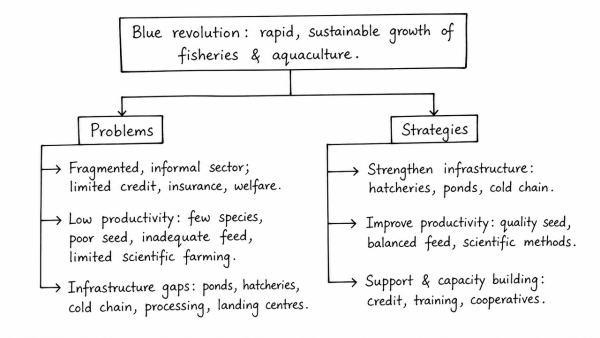
- Problems in pisciculture development
- Fragmented and informal sector: most fishers and fish farmers are small and lack access to formal credit, insurance and welfare benefits.
- Low productivity: dependence on a few species, poor quality seed, inadequate feed, and limited scientific farming reduce output.
- Infrastructure gaps: insufficient ponds, hatcheries, cold chain, processing units, landing centres and transport cause high post-harvest losses.
- Environmental stress: pollution, salinity changes, cyclones, rising तापमान, disease outbreaks and overfishing weaken fish stocks.
- Market constraints: price volatility, weak value addition and poor market linkage reduce farmer income.
- Strategies for development
- Strengthen institutional support through schemes for formalisation, financial inclusion, insurance and digital identity for fishers.
- Expand credit access via Kisan Credit Cards, concessional loans and credit guarantee support for aquaculture enterprises.
- Upgrade infrastructure: hatcheries, scientific ponds, ice plants, refrigerated transport, modern harbours and processing centres.
- Promote scientific aquaculture such as composite fish culture, biofloc, cage culture, recirculating systems and better seed certification.
- Diversify species and activities, including inland fisheries, brackish-water farming, ornamental fish and seaweed cultivation.
- Use digital platforms, traceability and market intelligence to improve planning, disease control and direct benefit delivery.
Thus, the blue revolution is not only about producing more fish, but also about making pisciculture climate-resilient, profitable and inclusive. A balanced approach of technology, credit, infrastructure and sustainability can unlock India’s full fisheries potential.
Originally written on
August 31, 2026
and last modified on
August 31, 2026.