Define the concept of carrying capacity of an ecosystem as relevant to an environment. Explain how understanding this concept is vital while planning for sustainable development of a region. (UPSC 2019)
Carrying capacity of an ecosystem means the maximum level of population, land use or resource extraction that nature can support over the long term without serious damage to its resource base, productivity or waste-absorbing ability. It is not a fixed number; it changes with climate, technology and management practices.
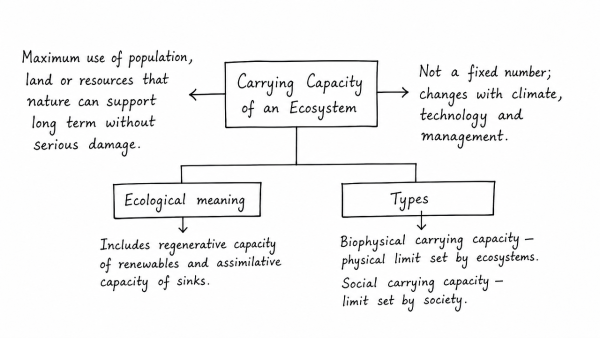
- Ecological meaning: It includes regenerative capacity of renewables such as forests, groundwater and soils, and assimilative capacity of sinks such as air, rivers and wetlands.
- Types: Biophysical carrying capacity is the physical limit set by ecosystems; social carrying capacity is the point beyond which infrastructure, services and quality of life begin to decline.
- Overshoot: When demand exceeds carrying capacity, ecosystems enter ecological debt, causing degradation, scarcity and possible tipping points.
| Why it matters in regional planning | Use in sustainable development |
| Land, water and forests | Fix safe limits for extraction, cropping intensity and urban expansion |
| Pollution and waste | Match industry and transport growth with air, water and solid waste capacity |
| Tourism and settlement | Decide caps on visitors, building density and infrastructure load |
- It helps prevent landslides, floods, groundwater depletion and air pollution.
- It supports cumulative impact assessment instead of project-wise piecemeal approvals.
- It guides better zoning, disaster risk reduction and equitable resource sharing.
Thus, carrying capacity is a practical planning tool for balancing growth with ecological limits. Regions that develop within these limits are more resilient, liveable and environmentally secure in the long run.
Originally written on
September 1, 2026
and last modified on
September 1, 2026.