Define mantle plume and explain its role in plate tectonics. (UPSC 2018)
A mantle plume is an upwelling of unusually hot, buoyant rock from deep within the mantle, possibly near the core-mantle boundary. It rises through the mantle as a narrow tail with a broader head, causing decompression melting beneath the lithosphere.
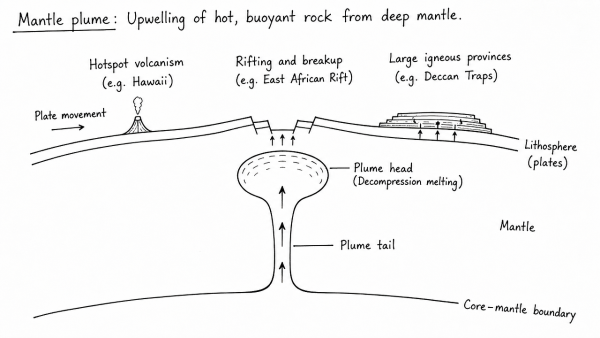
- Hotspot volcanism: As plates move over a relatively fixed plume, linear volcanic chains form, such as Hawaii and Yellowstone.
- Rifting and breakup: Plume heat weakens and domes the crust, helping initiate continental rifts and, at times, plate separation.
- Large igneous provinces: The plume head may produce vast flood basalts, as seen in the Deccan Traps and Siberian Traps.
- Plume-ridge interaction: Plumes can enhance magma supply at mid-ocean ridges and influence local plate motions.
Thus, mantle plumes are important because they add an intraplate and deep-mantle dimension to plate tectonics, though their role in rifting is often debated.
Originally written on
August 31, 2026
and last modified on
August 31, 2026.