Customs and traditions suppress reason leading to obscurantism. Do you agree? (UPSC 2020)
Customs and traditions do not always suppress reason, but they can do so when they become rigid, unquestioned and detached from human welfare. In such cases, they slide into obscurantism by discouraging inquiry, preserving prejudice and resisting reform.
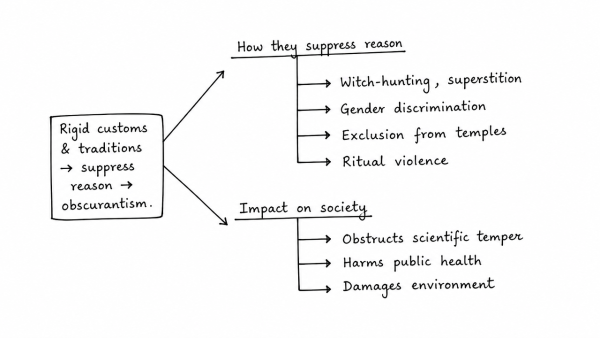
- How they suppress reason: practices justified as tradition have sustained witch-hunting, superstition, gender discrimination, exclusion from temples, and even ritual violence. Such customs often place fear and blind faith above evidence, dignity and constitutional morality.
- Impact on society: they can obstruct scientific temper, public health and environmental responsibility. Vaccine hesitancy, ritual excesses and rejection of modern medicine show how inherited beliefs may weaken rational decision-making.
- Why the view is not absolute: many customs also preserve social cohesion and carry practical wisdom. Sacred groves, traditional water harvesting, yoga and Ayurveda show that tradition can coexist with reason and even support sustainability.
- Role of reform: Indian history shows internal correction through Bhakti, Brahmo Samaj, Jyotirao Phule and other reform movements. The Constitution also protects freedom of religion, but subjects it to public order, morality, health and the duty to develop scientific temper.
Thus, customs and traditions are not inherently obscurantist; they become so when treated as immutable. Their value lies in their ability to evolve, submit to reason and serve human welfare rather than resist it.
Originally written on
September 2, 2026
and last modified on
September 2, 2026.