Cross-border movement of insurgents is only one of the several security challenges facing the policing of the border in North-East India. Examine the various challenges currently emanating across the India-Myanmar border. Also, discuss the steps to counter the challenges. (UPSC 2019)
The India-Myanmar border is a porous security frontier shaped by insurgency, ethnic ties, terrain and transnational crime, making policing far more complex than checking insurgent movement alone.
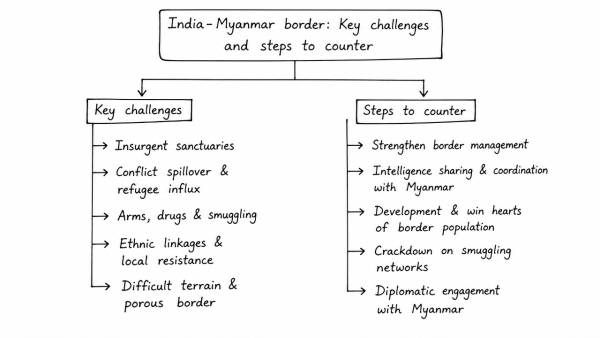
Key challenges
- Insurgent sanctuaries: Groups like NSCN-K and ULFA-I have used Myanmar territory for shelter, training and regrouping.
- Conflict spillover: Myanmar’s civil war has pushed refugees into Mizoram and Manipur, straining administration and heightening insecurity.
- Arms, drugs and smuggling: The route links to the Golden Triangle, facilitating heroin, methamphetamine, weapons and illicit trade.
- Ethnic linkages and local resistance: Kinship across the border among Naga and Kuki-Chin-Mizo groups complicates strict enforcement.
- Rugged terrain: Mountains, forests and river gaps make fencing, surveillance and patrolling difficult.
Countermeasures
- Complete fencing where feasible, build patrol roads and strengthen border outposts.
- Use drones, sensors, thermal imaging and smart surveillance in difficult stretches.
- Regulate cross-border movement through biometric passes and stricter screening under the Free Movement Regime.
- Enhance coordination among Assam Rifles, state police, intelligence agencies and civil administration.
- Engage Myanmar diplomatically and work with local communities for intelligence, lawful trade and trust-building.
A balanced strategy combining hard security, technology, diplomacy and community participation is essential to secure the border without alienating border populations.
Originally written on
September 1, 2026
and last modified on
September 1, 2026.