Critically examine why the rapid increase in Low Earth Orbit (LEO) satellite constellations poses a severe threat of space debris. How can global regulatory frameworks mitigate the Kessler syndrome?
Low Earth Orbit is becoming crowded at a pace that current safety systems were never designed to handle. The rise of mega-constellations, mostly in the 500-600 km band, has sharply raised collision risk and the chance of a debris cascade.
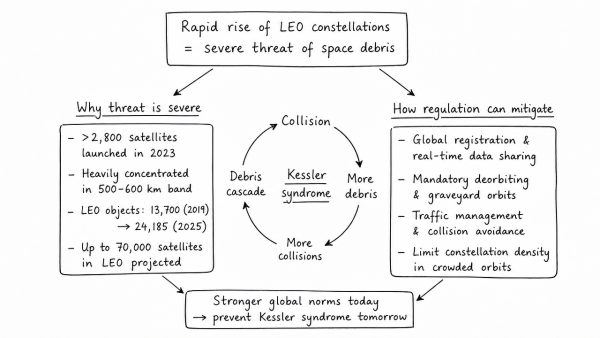
- Why the threat is severe
- More than 2,800 satellites were launched into LEO in 2023 alone; active payloads are now heavily concentrated in one orbital layer.
- LEO objects grew from about 13,700 in 2019 to 24,185 in 2025, while projections suggest up to 70,000 satellites may be in LEO by decade-end.
- Each collision can create thousands of fragments moving at several km per second. Even tiny pieces can disable satellites.
- Many fragments are too small to track: around 1.2 million are estimated in the 1-10 cm range, with far more below 1 cm.
- Large constellations need frequent avoidance manoeuvres; this drains fuel and increases the chance of operational error.
- Anti-satellite tests worsen the problem by creating long-lived debris clouds across key orbits.
- How regulation can reduce Kessler syndrome
- Make debris mitigation binding, not voluntary, with common rules on design, disposal and passivation.
- Shorten post-mission disposal deadlines, as some regulators now require de-orbit within 5 years instead of 25.
- Require system-level approvals for mega-constellations, not just satellite-by-satellite licences.
- Mandate collision data sharing, space traffic management and common tracking standards.
- Prohibit destructive ASAT tests and penalise debris-generating conduct.
- Support active debris removal for the most dangerous large derelicts.
Thus, the real test is collective discipline. Without enforceable global norms, commercial growth in LEO may turn valuable orbital bands into unusable debris fields for generations.
Originally written on
September 23, 2026
and last modified on
September 23, 2026.