Critically examine why the federal structure of India limits the Union’s power over cooperative societies, despite the 97th Constitutional Amendment. How can this legal friction be resolved?
The 97th Constitutional Amendment sought to strengthen cooperatives by giving them constitutional status, democratic control and professional management. Yet India’s federal design still limits the Union’s power because cooperatives remain, in large part, a State subject.
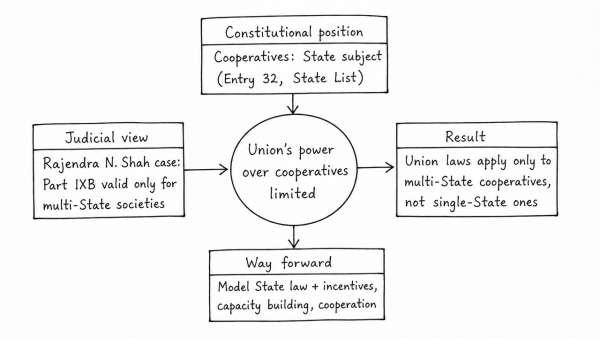
- Why the Union’s power is limited
- Entry 32 of the State List gives States exclusive power over cooperative societies within their territory.
- The Supreme Court held in Rajendra N. Shah v. Union of India that Part IXB is valid only for multi-State cooperative societies.
- For single-State cooperatives, the amendment was struck down because it touched a State List subject without ratification by at least half the State legislatures, as required by Article 368(2).
- This reaffirmed federalism as part of the basic structure and protected State autonomy.
- What the 97th Amendment still achieved
- It made the right to form cooperatives a fundamental right under Article 19(1)(c).
- It inserted Article 43B to promote voluntary formation, autonomous functioning and democratic control.
- It remains operative for multi-State cooperatives, which fall within Union competence.
- How to resolve the friction
- Any wider Union role needs a fresh constitutional amendment with State ratification, or a careful transfer of specific powers to the Concurrent List.
- For now, the Centre should focus on multi-State cooperatives, model laws, and policy guidance.
- States must lead on local cooperatives, while coordination can be improved through the Inter-State Council and NITI Aayog.
Thus, the conflict is not about the need for reform, but about constitutional competence. A cooperative model will work best when Union standards are pursued through consent, not central override.
Originally written on
September 23, 2026
and last modified on
September 23, 2026.