Critically examine why the 1950 Treaty of Peace and Friendship remains a point of contention in contemporary India-Nepal relations. How can both nations address these grievances?
The 1950 Treaty of Peace and Friendship was meant to secure India-Nepal ties, but today it is seen in Nepal as a symbol of asymmetry and in India as a source of security and border-management concerns.
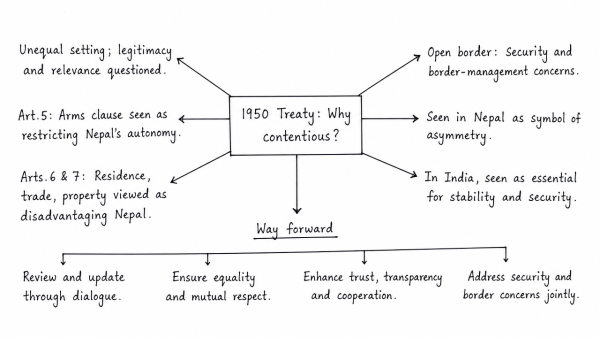
- Why it is contentious
- It was concluded in an unequal political setting, so many Nepalis question its legitimacy and continued relevance.
- Article 5 is criticised for constraining Nepal’s arms procurement through a consultation requirement.
- Articles 6 and 7 on residence, trade and property are viewed as disadvantaging Nepal, despite benefits of openness.
- The open border aids people-to-people links but also raises Indian concerns over trafficking, smuggling and illegal movement.
- The treaty does not resolve disputed areas like Kalapani, Lipulekh and Limpiyadhura, allowing territorial grievances to persist.
- How to address it
- Both sides should review the treaty clause by clause and update outdated provisions through mutual consent.
- Nepal’s sovereignty concerns and India’s security concerns should be balanced through clearer rules on arms, border movement and documentation.
A regular high-level dialogue, boundary mechanisms, and implementation of agreed recommendations can convert this legacy document into a modern framework of equality, trust and cooperation.
Originally written on
September 23, 2026
and last modified on
September 23, 2026.