
Critically examine the procedures through which the Presidents of India and France are elected. (UPSC 2022)
India and France elect their Presidents through markedly different constitutional designs: India uses an indirect, federal and parliamentary method, while France follows a direct, popular and majoritarian one.
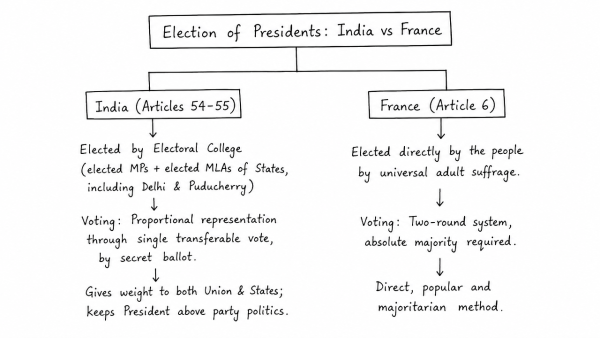
- India
Under Articles 54 and 55, the President is elected by an Electoral College of elected MPs and elected MLAs of States, including Delhi and Puducherry. Nominated members and MLCs are excluded. Voting is by proportional representation through the single transferable vote, by secret ballot. This gives weight to both Union and States and helps keep the President above party politics. However, the public has no direct role, so democratic legitimacy is indirect. The 1971 Census freeze has also limited changes in state vote weightage, raising questions of updated federal balance. - France
Under Articles 6 and 7, the President is elected by universal adult suffrage through a two-round system. If no candidate secures an absolute majority in the first round, the top two contest a runoff. The Constitutional Council supervises the process. This provides a strong popular mandate and encourages broader support, but also strengthens the presidency and can personalise politics. As France is unitary, the method is less about federal balance than about direct legitimacy.
Thus, India prioritises federal representation and institutional neutrality, whereas France prioritises direct democratic legitimacy and executive strength, each reflecting its constitutional structure and political needs.
Originally written on
September 3, 2026
and last modified on
September 3, 2026.
