Critically examine the ecological implications of deep-sea mining on fragile benthic ecosystems. How can sustainable harvesting technologies mitigate these environmental impacts?
Deep-sea mining targets polymetallic nodules, sulphides and crusts in ecosystems that are among the least understood on Earth. These benthic habitats are highly specialised, slow to recover and often host endemic species, so even limited disturbance can cause long-lasting damage.
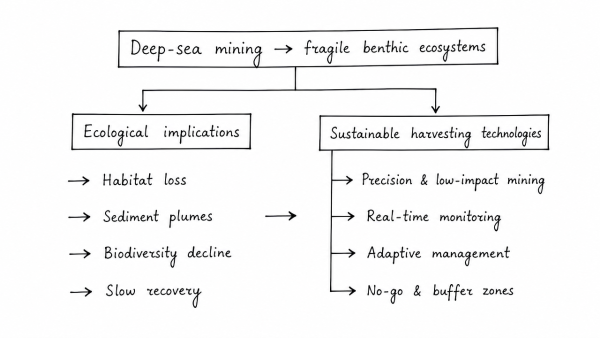
- Ecological implications
- Habitat loss: Seafloor scraping and removal destroy fauna, microbial mats and structural habitats.
- Sediment plumes: Disturbed sediments can smother filter feeders, reduce feeding efficiency and spread impacts far beyond the mine site.
- Biodiversity decline: Endemic and slow-growing species at vents and seamounts face local extinction; recovery may take decades or centuries, if at all.
- Noise, light and pollution: Machinery disrupts organisms adapted to dark, quiet conditions and may affect larger marine life too.
- Function loss: Disturbance can alter nutrient cycling and carbon storage, weakening the deep sea’s climate role.
- Why the risk is severe
- Many species are still undescribed, so full impact assessment is difficult.
- Deep-sea ecosystems have low productivity and extremely slow regeneration.
- How sustainable harvesting can help
- Precision robotics: AI-guided vehicles can target nodules or crusts selectively, reducing contact with surrounding sediments.
- Low-discharge systems: Avoiding mid-water dumping and using controlled lift and collection systems can cut plume spread.
- Real-time sensing: High-resolution mapping, video and acoustic monitoring can help operators avoid sensitive habitats.
- Adaptive management: Strong EIAs, continuous monitoring and shutdown triggers can limit harm during operations.
- Area protection: Excluding ecologically valuable zones through marine protected areas and precautionary rules is essential.
Even so, technology can only reduce, not remove, ecological damage. Sustainable harvesting must therefore be combined with strict regulation, circular use of minerals, and a precautionary approach before any large-scale deep-sea mining is allowed.
Originally written on
September 21, 2026
and last modified on
September 21, 2026.