Critically examine the aims and objectives of SCO. What importance does it hold for India? (UPSC 2021)
The Shanghai Cooperation Organisation was created to promote regional security and cooperation across Eurasia. For India, it is both a security forum and a platform to expand influence in Central Asia, while also facing clear limitations due to rivalry among members.
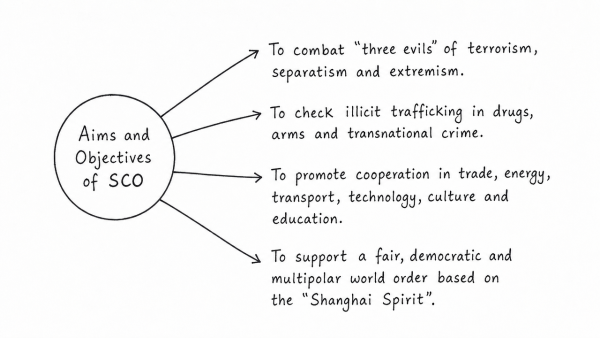
- Aims and objectives:
- To combat the “three evils” of terrorism, separatism and extremism.
- To check illicit trafficking in drugs, arms and transnational crime.
- To promote cooperation in trade, energy, transport, technology, culture and education.
- To support a more fair, democratic and multipolar world order based on the “Shanghai Spirit” of mutual trust, equality and respect for diversity.
- Critical concerns:
- The group often suffers from divergent threat perceptions, especially on terrorism.
- Economic cooperation is frequently overshadowed by China’s dominant role and BRI-linked projects.
- Bilateral disputes among members reduce trust and slow collective action.
- Its growing enlargement has widened its reach, but also made consensus harder.
- Importance for India:
- It gives India a seat at the high table of Eurasian geopolitics.
- It helps India engage Central Asia directly, bypassing Pakistan’s transit barrier.
- It supports cooperation against terrorism, radicalisation, cyber threats and narco-terrorism through SCO mechanisms.
- It complements India’s strategic autonomy by allowing dialogue with Russia, China and Iran without joining any bloc.
- It also aids connectivity and energy interests through INSTC and Chabahar-linked outreach.
Thus, the SCO is useful for India as a security and connectivity platform, but its effectiveness is limited by internal mistrust, China-centric economics and unresolved regional conflicts. India should use it pragmatically to advance counter-terrorism, Central Asian ties and a balanced Eurasian policy.
Originally written on
September 2, 2026
and last modified on
September 2, 2026.