Critically examine how the reliance on imported remotely piloted aircraft systems impacts India’s strategic autonomy. How can the government balance urgent security needs with indigenous capability building?
India’s reliance on imported remotely piloted aircraft systems (RPAS) helps meet urgent operational gaps, but it also creates strategic dependence in a domain where software, sensors and supply chains matter as much as platforms.
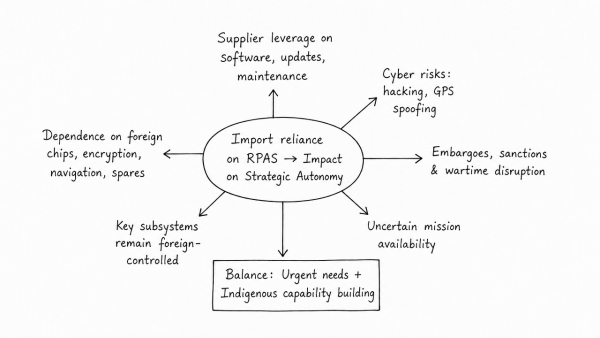
- Impact on strategic autonomy: High-end imports like MQ-9B enhance ISR and strike reach, yet key subsystems may remain foreign-controlled. Dependence on overseas chips, encryption, navigation and spares can expose fleets to embargoes, sanctions and wartime disruption. Supplier leverage may affect software updates, maintenance and mission availability. Import dependence also raises cyber risks such as hacking, GPS spoofing and data interception, while slowing domestic learning and weakening India’s defence industrial base.
- Balancing urgency and self-reliance: Use imports as bridge platforms for immediate security needs, not permanent dependence. Seek assembly in India, technology transfer, source-code access where feasible, and Indian control over upgrades and mission software. Prioritise indigenous and IDDM systems through fast-track procurement, while reserving imports for niche gaps. Expand iDEX, startup procurement, testing corridors and production incentives for drones, sensors, engines, batteries and counter-drone systems. Build secure communications and domestic electronics supply chains to reduce hidden import dependence.
A calibrated strategy—importing for immediate deterrence while systematically indigenising capabilities—best protects India’s strategic autonomy.
Originally written on
September 23, 2026
and last modified on
September 23, 2026.