Critically examine how the “dual-hazard paradox” of prolonged drought and violent rain bursts threatens India’s agricultural security. How can climate-smart farming mitigate this crisis?
India’s agriculture faces a dual-hazard paradox: prolonged drought weakens soils and crops, while violent rain bursts trigger flooding, erosion and waterlogging. Together, they make both rainfall deficit and excess equally damaging, destabilising farm output.
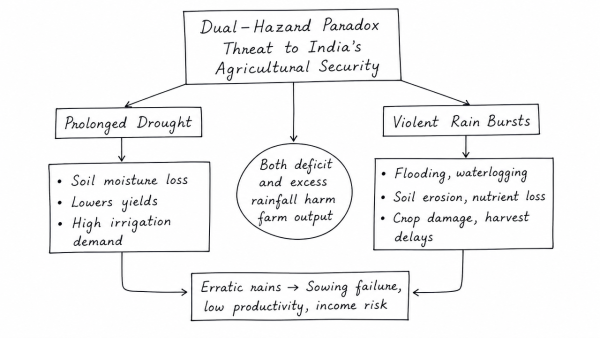
- Threat to agricultural security: Over 60% of cropped area depends on rainfed farming, so erratic showers cause sowing failure, poor germination and crop stress. Drought lowers soil moisture, raises irrigation demand and reduces groundwater recharge; intense rain often runs off before storage. Sudden downpours strip topsoil and nutrients, damage standing crops and delay harvesting and transport. Major crops such as rice, wheat, cotton and sugarcane face yield loss, pest attacks and price volatility, while repeated shocks deepen debt, cut fodder availability and threaten food and nutrition security.
- Why it is worsening: Rising temperatures increase evaporation and atmospheric moisture, making monsoon behaviour more erratic and extreme, with alternating drought and flood conditions even within the same season.
- Climate-smart response: Rainwater harvesting, farm ponds, check dams and micro-irrigation improve water security; mulching, cover crops, zero tillage and organic inputs conserve moisture and reduce erosion; drought-, heat- and submergence-tolerant short-duration varieties, crop diversification, agroforestry, millets and weather advisories spread risk and improve resilience.
Thus, climate-smart farming, supported by extension, insurance, credit and local water governance, is essential to convert vulnerability into resilience and protect India’s agricultural security.
Originally written on
September 12, 2026
and last modified on
September 12, 2026.