Critically examine how the absence of a statutory timeline under Article 200 for gubernatorial assent affects cooperative federalism. Suggest measures to reform this constitutional friction.
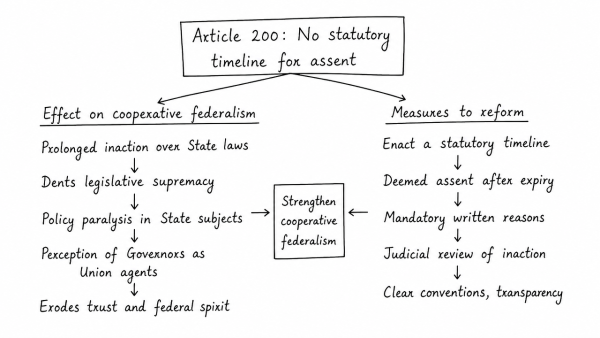
Article 200 gives the Governor four choices on a State Bill, but it does not fix a deadline. This silence has turned assent into a source of delay, uncertainty and political mistrust, weakening the federal spirit.
- Effect on cooperative federalism
- It allows prolonged inaction by an unelected office over laws made by elected State legislatures, which dents legislative supremacy.
- States face policy paralysis when welfare, taxation or regulatory Bills remain pending, even in areas within their authority.
- Frequent delay and selective action create the impression that Governors act as Union agents, not neutral constitutional heads.
- Litigation rises, making courts the arena for routine federal disputes and deepening Centre-State friction.
- Why this is constitutionally troubling
- The phrase “as soon as possible” implies prompt action, yet without a statutory or constitutional timeline it remains vague.
- Indefinite withholding also weakens accountability, because the Governor is not answerable to the State legislature.
- Measures for reform
- Insert a clear timeline through constitutional amendment, preferably 30 days for assent or return, and a longer but fixed period for reservation.
- Require a written, reasoned order for withholding assent or reserving a Bill.
- Adopt binding conventions, backed by Sarkaria and Punchhi-type guidance, to reduce discretionary misuse.
- Make the Governor’s appointment more consultative, with the Chief Minister’s views recorded.
- Use the Inter-State Council to evolve common norms and prevent repeated confrontations.
A time-bound, transparent and consultative process would preserve the Governor’s constitutional role while restoring trust between the Union and the States. Cooperative federalism can function only when assent is a safeguard, not a veto by delay.
Originally written on
September 13, 2026
and last modified on
September 13, 2026.