Critically examine how rapid, unplanned urbanization in India has heightened vulnerability to urban flooding. How can river-centric urban planning mitigate this?
Rapid, unplanned urbanisation has turned many Indian cities into flood-prone concrete catchments. By shrinking natural buffers and overloading drainage, it has converted heavy rain into urban disaster rather than a manageable event.
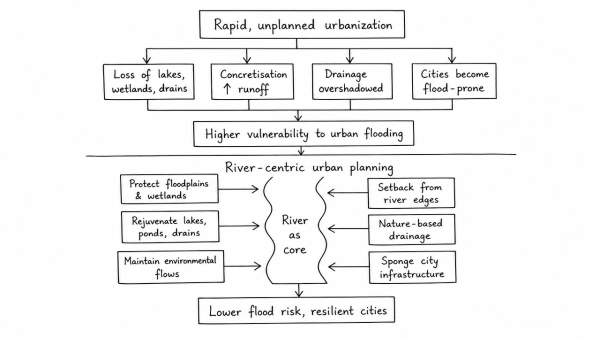
- How urbanisation increases vulnerability: Encroachment on lakes, wetlands, marshes and natural drains reduces storage and slows outflow. Bengaluru has lost nearly 80% of its water bodies, while Chennai’s Pallikaranai marsh has shrunk sharply.
- Concretisation intensifies runoff: Roads, roofs and pavements block infiltration, so water moves faster into drains. Old drainage systems, often designed for much lower rainfall, cannot cope with present-day extremes.
- Floodplain misuse worsens risk: Construction on riverbeds and floodplains narrows carrying capacity and removes the river’s natural spill space. Poor waste disposal further clogs drains and channels.
- Climate stress and weak governance: Short, intense cloudbursts now combine with fragmented urban management, poor maintenance and weak enforcement of land-use rules.
| River-centric planning | Mitigation gains |
| Protect floodplains and river corridors | Preserves natural detention space and reduces peak flooding |
| Restore wetlands, lakes and riparian buffers | Improves storage, recharge and water quality |
| Use blue-green infrastructure | Permeable surfaces, bioswales and rain gardens cut runoff |
| Plan by micro-catchment | Aligns drainage, land use and river ecology |
Thus, urban flood management must move from drain-centred engineering to river-centric resilience. Cities should treat rivers as living systems, not as encroached channels, and combine strict zoning, ecosystem restoration and better governance.
Originally written on
September 13, 2026
and last modified on
September 13, 2026.