Critically discuss why traditional Keynesian deficit stimulus fails to resolve structural unemployment caused by automation. How should fiscal policy adapt to foster AI-complementary jobs?
Traditional Keynesian deficit stimulus is useful when unemployment is caused by weak demand. It is much less effective when automation destroys tasks and changes the skill mix of jobs, because the core problem is not missing spending but a labour-market mismatch.
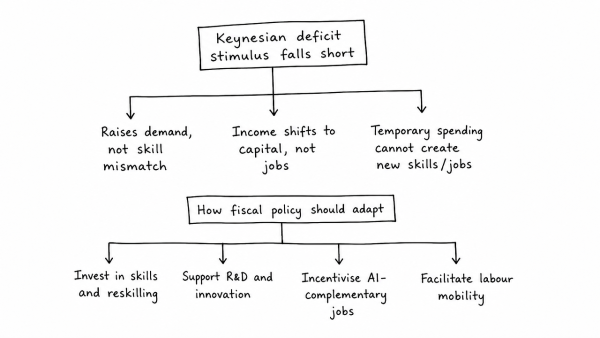
- Why Keynesian stimulus falls short
- It raises aggregate demand, but structural unemployment is driven by skills that no longer match new technologies.
- Automation shifts income from labour to capital, so higher demand may lift profits and asset values more than jobs.
- Temporary deficit spending cannot by itself create the long-term training, mobility and institutional change needed for displaced workers.
- Large stimulus without productive capacity can worsen debt pressures and inflation, while leaving low-skill workers behind.
- Why the impact is uneven
- New jobs created by AI often require digital, analytical and human-centred skills.
- Workers in routine manufacturing, clerical and service roles may not benefit without retraining.
- Regions dependent on automatable industries may face prolonged adjustment costs.
- How fiscal policy should adapt
- Shift spending from general demand support to human capital: AI literacy, skilling, apprenticeships and reskilling vouchers.
- Fund public education, vocational institutes and industry-linked training in data, cybersecurity, repair, design and care work.
- Use tax credits for firms that retrain workers and redesign jobs for human-AI collaboration.
- Strengthen wage insurance, unemployment support and portable benefits for transition periods.
- Encourage public investment in sectors where AI complements labour: health, education, logistics, climate services and public administration.
Thus, fiscal policy must move from short-run demand management to structural capability building. The aim should be not to resist automation, but to ensure that AI raises productivity while creating more, better and human-complementary work.
Originally written on
September 13, 2026
and last modified on
September 13, 2026.