Critically discuss why Indian conservation policies historically neglect grassland ecosystems. How has this classification deficit impacted the survival of endemic semi-arid species like the Lesser Florican?
Forest bias in policy Indian conservation has historically privileged forests, treating grasslands, savannas and semi-arid open habitats as “wastelands” or degraded land. Colonial priorities, forest-centric laws and revenue maps erased their ecological status, while afforestation and development projects further converted them for farming, roads, industry and plantations.
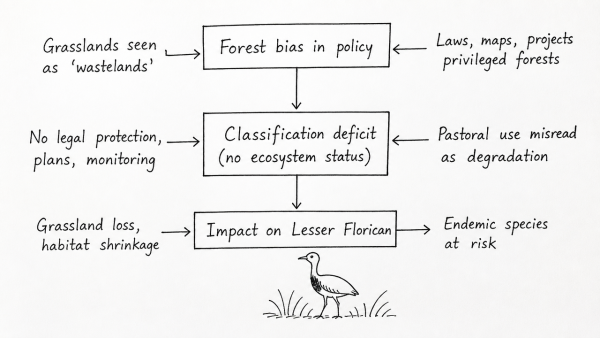
- Classification deficit Because grasslands were not recognised as a distinct ecosystem, they lacked dedicated legal protection, management plans and monitoring. Traditional grazing and pastoral use were often misread as degradation rather than a sustainable land-use system.
- Ecological consequence Native grass cover, soil moisture and open-habitat structure were altered by tree planting, invasive species and fragmentation, reducing habitat quality for specialised fauna.
Effect on the Lesser Florican The Lesser Florican, an endemic semi-arid grassland bird, depends on open grassy landscapes for breeding and display; habitat loss, disturbance, power lines, pesticides and patch isolation have caused severe decline, pushing it towards critical endangerment.
Thus, the key failure is not only habitat loss but invisibility in classification, which allowed grasslands to be routinely diverted without conservation safeguards.