Critically discuss why India remains highly dependent on edible oil imports despite its agrarian strength. How can crop diversification toward oilseeds be structurally incentivized?
India’s agrarian base has not translated into edible oil self-reliance because production choices, yields and markets are misaligned. Rising consumption has outpaced oilseed output, so imports now meet a majority of demand.
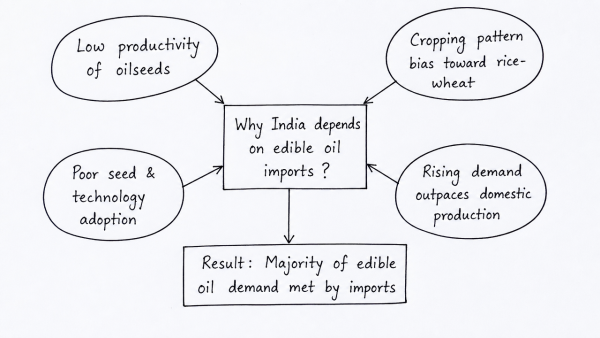
Why dependence persists
- Low productivity: Oilseed yields remain well below global levels. Much of the crop is grown on rainfed land, making output unstable.
- Cropping pattern bias: Rice and wheat often offer lower risk, assured procurement and better returns than oilseeds, especially where irrigation is available.
- Poor seed and technology adoption: Low seed replacement, weak extension, limited mechanisation and uneven access to quality inputs keep yields depressed.
- Weak market support: MSP exists, but procurement is patchy. Farmers face price volatility and delayed payments.
- Import competition: Cheap palm and soybean oils depress domestic prices, reducing the incentive to shift acreage to oilseeds.
How diversification can be incentivised
- Assured price realisation: Expand effective MSP procurement and price deficiency payment for oilseeds, not just cereals.
- Better cropping economics: Offer input subsidies, crop insurance, and targeted viability support in high-potential districts.
- Seed and technology push: Scale high-yielding, climate-resilient varieties, seed hubs, and extension through KVKs and FPOs.
- Water-smart cultivation: Promote micro-irrigation, intercropping, and use of rice fallows for mustard, sesame and pulses-oilseed systems.
- Value-chain development: Invest in procurement centres, storage, processing and local crushing so farmers capture more value.
- Trade calibration: Use import duty and standards carefully to protect domestic growers without raising consumer prices sharply.
Thus, oilseed self-reliance needs a shift from token subsidies to a full ecosystem of price assurance, technology, irrigation and market reform. Only then will farmers treat oilseeds as a reliable and profitable alternative to cereals.
Originally written on
September 12, 2026
and last modified on
September 12, 2026.